
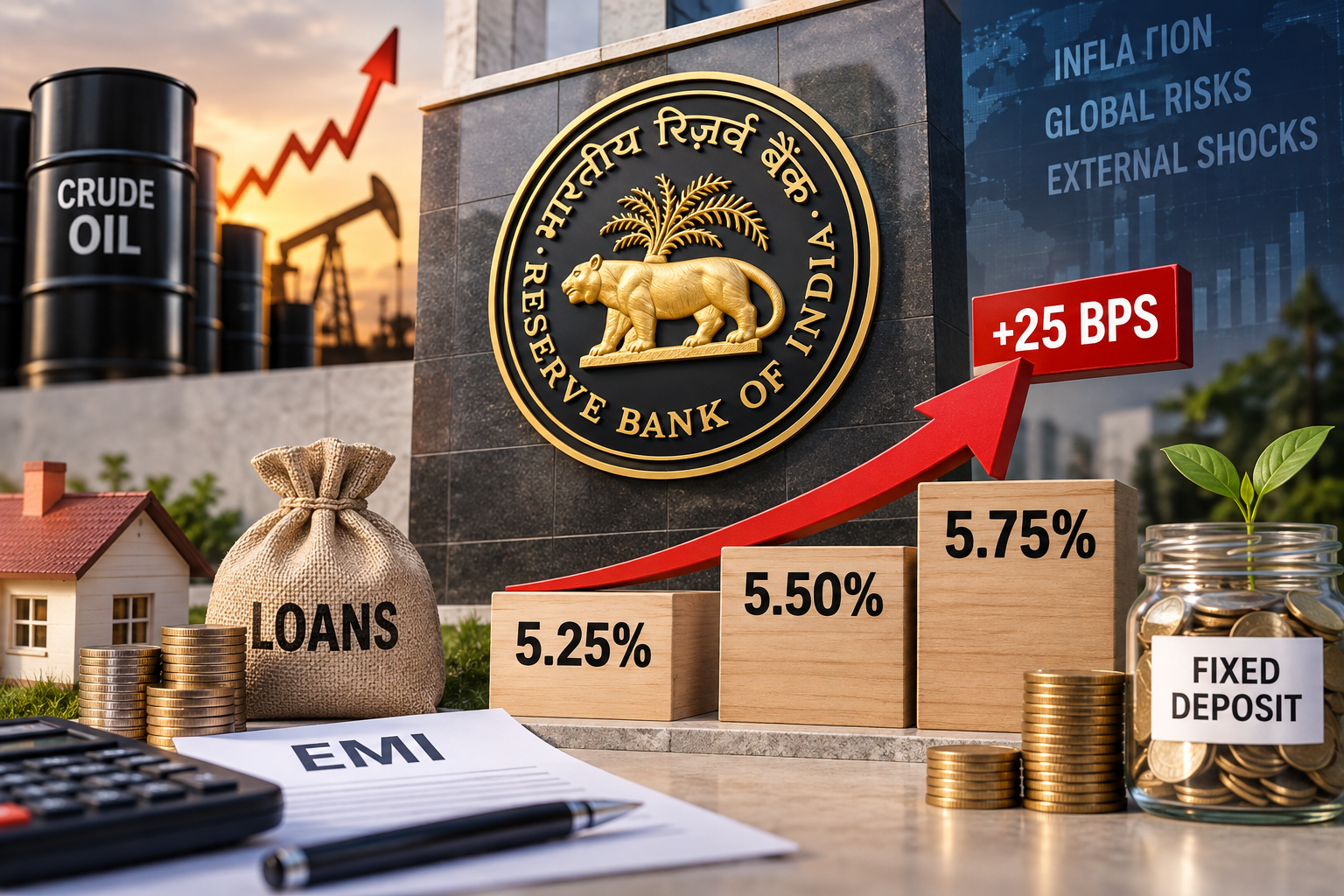
Loan interest Loan interest rates, EMIs to rise? Two back-to-back 25 bps repo rate hike from RBI soon?rates, EMIs to rise? Two back-to-back 25 bps repo rate hike from RBI soon?
The RBI is expected to hike the benchmark interest rate by 25 basis points in October and December due to rising crude prices and inflationary pressures. Changes in the repo rate will affect borrowers and depositors. Here's how.
The Reserve Bank of India (RBI) is likely to raise the benchmark interest rate by 25 basis points next month and again in December as a countermeasure to rising crude prices, persistent external shocks and signs of broader inflationary pressures, SBI Research said its Ecowrap report published on Friday.
“We strongly advocate a 25-bps rate hike in the upcoming October policy (followed by another in December in quick succession),” the report said.
In August, the apex bank kept the repo rate unchanged at 5.25% for the fourth consecutive review. The next meeting of the Monetary Policy Committee (MPC), the RBI's rate-setting panel, is scheduled for October 5-7, 2026.
The SBI report also noted that the expected repo rate hikes would be driven by evolving economic risks, rather than being linked to any potential action by the US Federal Reserve. It cited the RBI's approach in 2022 as a precedent.
How will it impact loan interest rates, EMIs, FD rates?
The central bank's decision to raise interest rates usually has a direct bearing on millions of borrowers and depositors.
The relationship between repo rates and fixed deposit (FD) rates is closely linked. When the repo rate rises, financial institutions often increase FD rates. If the repo rate rises over the next three months as anticipated, investors will have an opportunity to lock in higher interest rates on their deposits
For example, during the Covid-19 pandemic, the RBI slashed the repo rate by as much as 115 basis points to 4% over several policy reviews, which led to lower FD rates. However, as inflationary pressures increased, the RBI raised the repo rate, leading to an improvement in FD rates.
Similarly, the repo rate also indirectly affects interest rates on loans since it is the cost at which banks borrow from the central bank. When the policy rate in increased, banks may adjust lending rates to align with the revised borrowing costs. This can result in changes to loan interest rates or EMIs, particularly for borrowers with floating-rate loans.
For new loan borrowers, a repo rate hike can make borrowing more expensive. Floating-rate loans are linked to repo rate and thus their interest rates may move in response to changes in the policy rate. Fixed-rate loans, however, remain unchanged until they are refinanced.
For example: You have a home loan of ₹50 lakh with a tenure of 20 years at a floating interest rate of 8.25%. At this rate, your monthly EMI will come to ₹42,603. Now, if the RBI increases the repo rate from 5.25% to 5.75% and your bank passes on the entire 50 basis points hike, your home loan interest rate could increase to 8.75%. As a result, your EMI would increase to approximately ₹44,186, assuming the loan tenure remains unchanged.